How a Neural Network Mimics the Human Brain and to What Extent

Yash Raj | Posted on May 31, 2024
Table of Contents
Abstract Understanding Neural Networks Key Similarities Between Neural Networks and the Human Brain Differences and Limitations Applications and Real-World Impact Future DirectionsAbstract
The study of neural networks is deeply rooted in the attempt to understand and replicate the complex mechanisms of the human brain. This blog post delves into how neural networks mimic brain functions and the extent to which they achieve this feat. By exploring the structural and functional similarities, we uncover the remarkable parallels and distinct differences between artificial neural networks (ANNs) and biological neural networks. The discussion extends to the applications of ANNs in various fields, demonstrating their capabilities and limitations in mimicking human cognition and problem-solving. Furthermore, the post addresses the future directions of neural network research and its potential to bridge the gap between artificial and biological intelligence.
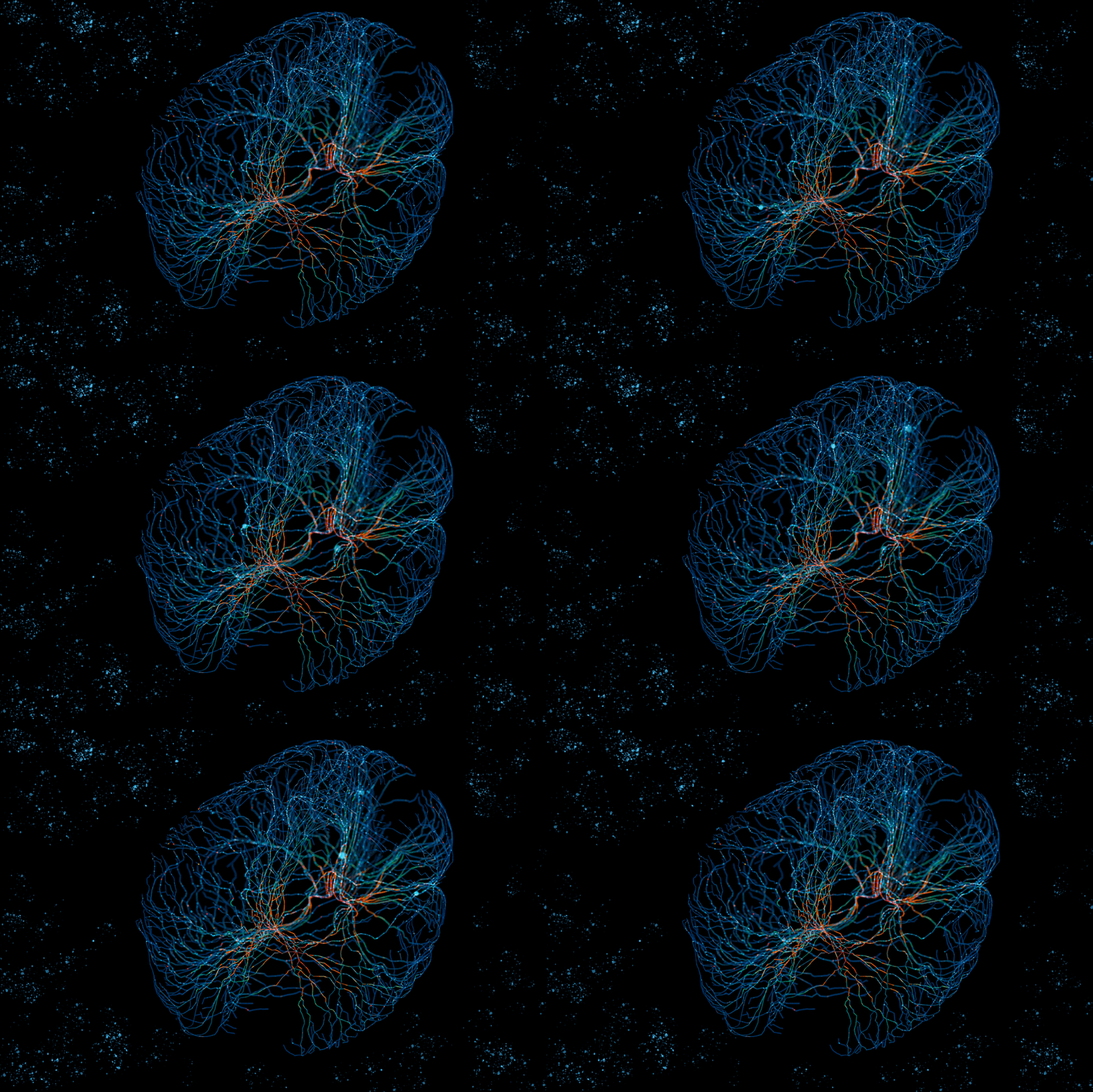
Understanding Neural Networks
Neural networks are a subset of machine learning algorithms inspired by the human brain's structure and function. Composed of interconnected nodes (neurons) organized into layers, these networks process information in a manner analogous to biological neural networks. The primary components of an artificial neural network include the input layer, hidden layers, and output layer, each playing a crucial role in data processing and pattern recognition. The design of ANNs aims to replicate the way neurons communicate in the brain through synapses. Information flows through the network as inputs are multiplied by weights, summed, and passed through an activation function to produce outputs. This process, akin to synaptic transmission, enables ANNs to learn from data, recognize patterns, and make predictions.
Key Similarities Between Neural Networks and the Human Brain
The similarities between ANNs and the human brain are evident in their structural and functional characteristics:
- Layered Architecture: Both ANNs and the brain have a layered structure, with neurons organized in layers that process information sequentially.
- Learning Mechanisms: The process of training a neural network parallels synaptic plasticity in the brain, where connections are strengthened or weakened based on experience and learning.
- Pattern Recognition: ANNs excel at recognizing patterns in data, much like the human brain identifies patterns in sensory input.
Differences and Limitations
Despite the similarities, significant differences exist between ANNs and the human brain:
Complexity and Scale the human brain consists of approximately 86 billion neurons and trillions of synapses, far surpassing the complexity of current neural networks. Energy Efficiency the brain is highly energy-efficient, operating on roughly 20 watts of power, whereas neural networks, especially deep learning models, require substantial computational resources. Cognitive Flexibility, human cognition is characterized by adaptability and generalization, abilities that ANNs struggle to fully replicate.
Applications and Real-World Impact
Neural networks have found applications across various domains, demonstrating their potential to mimic certain aspects of human intelligence:
In healthcare, ANNs assist in diagnosing diseases, analyzing medical images, and predicting patient outcomes. Talking about finance, financial institutions use neural networks for fraud detection, algorithmic trading, and risk assessment. Automotive Neural networks are integral to the development of autonomous vehicles, enabling perception, decision-making, and control.
Future Directions
The future of neural network research lies in addressing current limitations and pushing the boundaries of artificial intelligence. Key areas include Neuromorphic Computing which concerns about developing hardware that mimics the brain's architecture to enhance computational efficiency and speed. In Explainable AI, creating models that provide transparent and interpretable results, addressing the "black box" nature of neural networks. Also in interdisciplinary research, combining insights from neuroscience, cognitive science, and machine learning to develop more advanced and brain-like neural networks.
References
[1] Image source: "neuronsresearch" Neural Networks and the Brain : A
Comparative Analysis.
Visit
Article
(accessed May 31, 2024).
[2] National Centre for Biotechnology Information. National Institutes
of
Health : How can artificial neural networks approximate the brain? -Feng Shao* and Zheng Shen
Visit Article
(accessed May 30, 2024).